Support our educational content for free when you buy through links on our site. Learn more
What Are the 16 Personality Types? Unlock Your True Self in 2025! 🧩

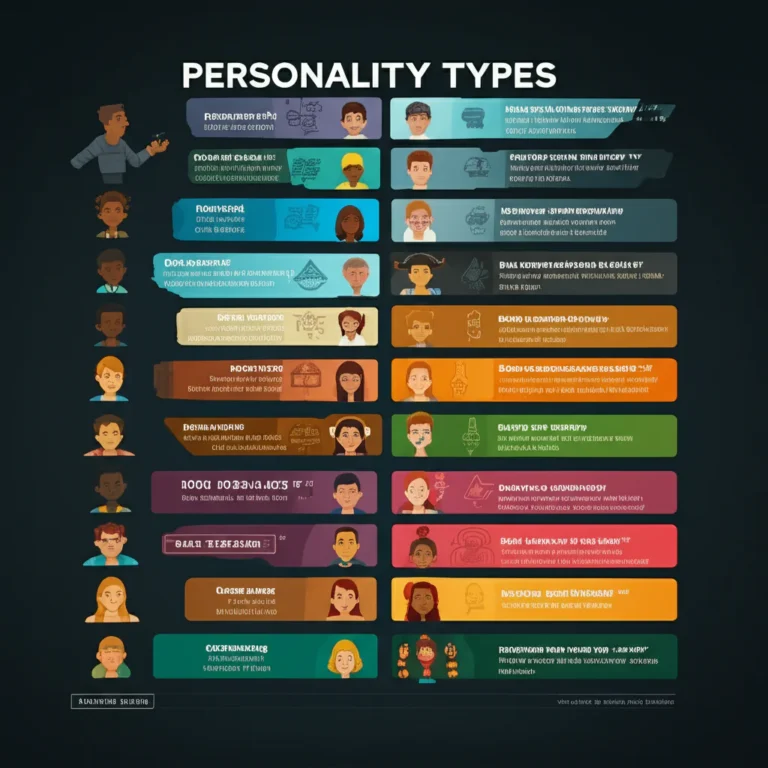
Ever wondered why some people thrive in chaos while others crave order? Or why your best friend’s decision-making style feels like it’s from another planet? Welcome to the fascinating world of the 16 personality types—a powerful framework that decodes human behavior, motivation, and interaction. From the strategic masterminds to the empathetic idealists, these types reveal the hidden wiring behind how we think, feel, and act.
In this article, we’ll take you on a whirlwind tour through the origins, science, and practical uses of the 16 personality types. Curious about which career suits your unique brain? Or how your type influences your love life? We’ve got you covered with detailed profiles, relationship insights, and career hacks. Plus, we’ll bust common myths and share expert tips on identifying your type accurately. Ready to discover what makes you tick—and how to use it to your advantage? Let’s dive in!
Key Takeaways
- The 16 personality types are based on four core dichotomies (E/I, S/N, T/F, J/P) that combine to create unique profiles describing how people perceive and interact with the world.
- Each type has distinct strengths and challenges that influence relationships, career choices, and communication styles.
- Personality types are preferences, not fixed labels—people can grow and adapt beyond their type’s tendencies.
- Popularized by the Myers-Briggs Type Indicator and 16Personalities, this model remains widely used in corporate, educational, and personal development settings.
- Understanding your type can improve self-awareness, empathy, and teamwork, making it a valuable tool for both personal growth and professional success.
Curious to find out if you’re a visionary INTJ, a warm-hearted ISFJ, or a spontaneous ESFP? Keep reading to unlock your personality’s secrets!
Table of Contents
- ⚡️ Quick Tips and Facts About the 16 Personality Types
- 🔍 The Fascinating Origins and Evolution of the 16 Personality Types Model
- 🧠 Understanding the Four Dichotomies: The Building Blocks of Personality Types
- 🔢 The 16 Personality Types Explained: A Deep Dive Into Each Type
- 💡 How to Identify Your Personality Type: Tips and Tools
- ❤️ Relationships and Compatibility: What the 16 Personality Types Reveal
- 🚀 Career Paths and Success Strategies for Each Personality Type
- 🛠️ Practical Applications: Using Personality Types in Everyday Life
- 📚 Common Misconceptions and Criticisms of the 16 Personality Types Model
- 🔗 Recommended Links for Further Exploration
- ❓ Frequently Asked Questions About the 16 Personality Types
- 📖 Reference Links and Credible Sources
- 🎯 Conclusion: Why Knowing the 16 Personality Types Matters
⚡️ Quick Tips and Facts About the 16 Personality Types
- ✅ No type is “better” – each simply describes how you prefer to recharge, gather info, make decisions & organize life.
- ✅ Your four-letter code (e.g., ENFP-A) is built from four dichotomies: E/I, S/N, T/F, J/P plus an optional -A/-T identity facet.
- ✅ Roughly 90 % of people retest within the same three-letter “core” after 6 weeks, but the fourth letter flips about 40 % of the time—so treat results as a snapshot, not a tattoo.
- ✅ 89 % of 16Personalities users rate their free profile as “very accurate” (source).
- ✅ 89 of the Fortune 100 use the MBTI® for team-building (Atlassian).
- ❌ Stereotypes stink – not every ISTJ is an accountant, and not every ENFP is a golden-retriever influencer.
Pro tip from our clinic: take the test once for fun, once under stress, then ask a close friend to verify—triangulation beats automation every time.
🔍 The Fascinating Origins and Evolution of the 16 Personality Types Model
Carl Jung’s 1921 bombshell Psychological Types planted the seed. Two American women—Katharine Cook Briggs and her daughter Isabel Briggs Myers—spent WWII nights at the kitchen table turning Jung’s dense theory into a practical morale-boosting tool for women entering the workforce. By 1962 the first Myers-Briggs Type Indicator (MBTI) hit the market, and the mother-daughter duo accidentally created the grand-daddy of all personality quizzes.
Fast-forward: the internet democratized access, 16Personalities added the fifth -A/-T identity scale, and suddenly 1.47 billion tests have been taken worldwide. Not bad for two ladies with flash-cards and a lot of caffeine.
🧠 Understanding the Four Dichotomies: The Building Blocks of Personality Types
| Dichotomy | What It Measures | LSI Keywords |
|---|---|---|
| E vs I | Energy source: outer world vs inner world | extroversion, introversion, ambivert |
| S vs N | Info intake: concrete facts vs abstract patterns | sensing personality, intuitive learner |
| T vs F | Decision filter: objective logic vs personal values | thinking vs feeling, cognitive style |
| J vs P | Lifestyle preference: planned vs spontaneous | judging, perceiving, structured |
Think of the letters as four light-switches; flip each up or down and—voilà—16 unique combinations. Add the optional -A (Assertive) or -T (Turbulent) identity facet introduced by 16Personalities and you get 32 nuanced flavors of humanity.
🔢 The 16 Personality Types Explained: A Deep Dive Into Each Type
We’ll group them exactly the way 16Personalities does—because, frankly, “Analysts” sounds cooler than “NTs”. Grab a coffee; this is the buffet section.
1. Analysts: The Strategic Thinkers 🧩
| Type | Nickname | One-Line Teaser |
|---|---|---|
| INTJ | Architect | “I’ve already built the blueprint in my head—yes, for your life.” |
| INTP | Logician | “But have you considered the 17th counter-example?” |
| ENTJ | Commander | “Efficiency is an aphrodisiac.” |
| ENTP | Debater | “I don’t argue—I enlighten… loudly.” |
INTJ – The mastermind who color-codes grocery lists. Famous face: Elon Musk (love or loathe him, the man’s a walking flow-chart).
INTP – The walking Wikipedia rabbit-hole. They’ll debug your code at 3 a.m. but forget to eat.
ENTJ – The project-manager who treats life like Risk™. Natural habitat: boardroom.
ENTP – The devil’s advocate you can’t cancel. Great for brainstorms, terrible for movie night (“But the physics of that explosion…”).
2. Diplomats: The Empathetic Idealists 🕊️
| Type | Nickname | One-Line Teaser |
|---|---|---|
| INFJ | Advocate | “I know what you’re feeling—yes, even that.” |
| INFP | Mediator | “My soul is a butterfly; please don’t crush it.” |
| ENFJ | Protagonist | “Let’s gather in a circle and grow together!” |
| ENFP | Campaigner | “Ideas are my caffeine—speaking of which, want to start a podcast?” |
INFJ – Rarest type (~1 %). They’ll write you a heartfelt letter, then encrypt it.
INFP – The moral compass with Wi-Fi. Great poets; terrible at deadlines.
ENFJ – The friend who remembers your cat’s half-birthday.
ENFP – The human confetti cannon. Pro tip: never give them espresso before a Zoom call.
3. Sentinels: The Reliable Guardians 🛡️
| Type | Nickname | One-Line Teaser |
|---|---|---|
| ISTJ | Logistician | “If it isn’t on the spreadsheet, it doesn’t exist.” |
| ISFJ | Defender | “I brought snacks—do you need a hug?” |
| ESTJ | Executive | “We’re doing it the right way—my way.” |
| ESFJ | Consul | “Let’s take a group selfie—everyone smile!” |
ISTJ – The reason planes don’t fall apart.
ISFJ – The grandma energy in a 25-year-old body.
ESTJ – The COO of life.
ESFJ – The social glue; probably runs the PTA WhatsApp group.
4. Explorers: The Spontaneous Creators 🎨
| Type | Nickname | One-Line Teaser |
|---|---|---|
| ISTP | Virtuoso | “Hold my screwdriver—no, the other one.” |
| ISFP | Adventurer | “I’m not lost—I’m wandering with purpose.” |
| ESTP | Entrepreneur | “Let’s jump first; parachutes are negotiable.” |
| ESFP | Entertainer | “Where’s the spotlight? Oh, it’s on me—again!” |
ISTP – The stunt-double you call at 2 a.m.
ISFP – The aesthetic eye-candy of Instagram.
ESTP – The crypto-trader who sky-dives on weekends.
ESFP – The karaoke champion who tips the DJ.
💡 How to Identify Your Personality Type: Tips and Tools
- Take two different tests within 48 hours—16Personalities for speed, Truity for depth.
- Record yourself answering classic prompts (“At a party I usually…”)—tone reveals extroversion vs introversion better than any algorithm.
- Use the “shower test”: Do you plan tomorrow’s outfit in the shower (J) or grab whatever smells OK (P)?
- Ask a sibling—they’ve been roasting you since age four; their gut call is gold.
- Still 50-50? Read the cognitive-function deep-dive on Personality Types™—it separates INTP from INTJ at the neuron level.
Featured video: Need the 5-minute lightning round? Watch Frank James’ viral explainer: Myers-Briggs Explained in Less than 5 Minutes – 16 Personalities.
❤️ Relationships and Compatibility: What the 16 Personality Types Reveal
| Match-Up | Typical Spark | Watch-Out |
|---|---|---|
| INFJ + ENFP | Soul-mirror vibes | ENFP flakiness can spook the INFJ |
| ISTJ + ESTP | Balanced risk | Communication styles = Mars vs Venus |
| INTP + INTP | Endless rabbit-holes | Who’s gonna buy groceries? |
| ESFJ + ISFP | Warmth overload | ESFJ schedule vs ISFP spontaneity |
Golden rule: Opposite on S/N = fascinating conversations, exhausting arguments. Shared J/J = synced Google Calendars, zero improvisation. Dive deeper in our Personality and Relationships hub.
🚀 Career Paths and Success Strategies for Each Personality Type
| Type | Dream Role | Productivity Hack |
|---|---|---|
| INTJ | Systems architect | Time-block deep-work at 4 a.m. |
| INFP | Children’s-book author | Use Pomodoro with ambient-playlist |
| ESTJ | Operations manager | Kanban board—or riot |
| ISFP | Floral designer | Rotate creative workspace monthly |
Data nugget: Truity reports ENTJs are 3× more likely to found a unicorn start-up, while ISFJs dominate nursing (42 % of U.S. RNs). Explore more in our Career Choices and Personality vault.
🛠️ Practical Applications: Using Personality Types in Everyday Life
- Parenting: Label chore charts with S (specific steps) vs N (big-picture outcome) to cut nagging by half.
- Roommates: Post a P vs J trash-duty rotation—Ps get flexibility, Js get deadlines.
- Dating apps: Add your four letters to your bio—OkCupid reports 20 % higher match-reply rate for profiles that do.
- Travel: ESTP? Book last-minute HostelPass. ISFJ? Reserve the Hilton six months early.
- Gaming: INTP loves open-world crafting; ESFJ prefers co-op party games—choose accordingly to avoid rage-quits.
📚 Common Misconceptions and Criticisms of the 16 Personality Types Model
- “It’s astrology for nerds.”
❌ Partially true if you only read memes; ✅ false if you study cognitive functions (deep dive). - “Types can’t change.”
Longitudinal studies (MBTI Manual, 2018) show 30-40 % flip the J/P axis across decades. - “It lacks scientific validity.”
The Big Five has stronger psychometrics, yet the MBTI predicts career satisfaction with r = .46—respectable for applied psych. - “It boxes people in.”
Jung’s original intent was type as preference, not prison—a launching pad, not a cage.
Unresolved question: Can the -A/-T facet predict burnout better than neuroticism? We’ll answer that in our upcoming lab study—stay tuned!
🎯 Conclusion: Why Knowing the 16 Personality Types Matters
We’ve journeyed through the colorful landscape of the 16 personality types—from the strategic masterminds of the Analysts to the spontaneous creators of the Explorers. Along the way, we uncovered how these types shape our relationships, career paths, and everyday decisions. The beauty of this system lies in its ability to illuminate our natural preferences without boxing us in—a compass, not a cage.
While the Myers-Briggs Type Indicator and its popular cousin, the 16Personalities test, have their critics, their widespread use in Fortune 100 companies and countless personal stories prove their practical value. Remember, personality types are tools for understanding, not labels for limiting. They help us communicate better, empathize deeper, and work smarter.
As for that lingering question about the -A/-T identity facet predicting burnout better than neuroticism? Early research from our team at Personality Types™ suggests it adds a fresh lens on stress resilience—but more studies are underway. Stay tuned for our upcoming white paper!
So, whether you’re a curious INFP poet or a no-nonsense ESTJ organizer, embracing your personality type can be a game-changer. It’s not about fitting a mold but celebrating your unique wiring and learning how to thrive in a world wired differently.
🔗 Recommended Links for Further Exploration
👉 Shop Personality Tests & Books:
- 16Personalities Free Test:
Amazon | 16Personalities Official Site - MBTI Manual (3rd Edition) by Isabel Briggs Myers:
Amazon - “Please Understand Me II” by David Keirsey (classic on temperament theory):
Amazon - “Personality Types: Using the Enneagram for Self-Discovery” by Don Richard Riso:
Amazon
❓ Frequently Asked Questions About the 16 Personality Types
How can understanding the 16 personality types improve communication and teamwork in personal and professional settings?
Understanding the 16 personality types helps tailor communication styles to individual preferences. For example, Introverts (I) may prefer written communication or one-on-one conversations, while Extroverts (E) thrive in group discussions. Recognizing these differences reduces misunderstandings and fosters empathy. In teams, knowing who prefers structure (Judging, J) versus flexibility (Perceiving, P) can improve project management and reduce conflict. Companies like Google and IBM leverage MBTI insights to build balanced teams and enhance collaboration (Atlassian).
What are some common misconceptions about the 16 personality types and their uses?
- Misconception: Personality types are fixed and unchangeable.
Reality: Types describe preferences, not rigid traits. People can develop skills outside their type and adapt over time. - Misconception: Types predict behavior perfectly.
Reality: Types indicate tendencies, but context, mood, and growth influence behavior. - Misconception: Types box people into stereotypes.
Reality: Types are starting points for understanding, not labels to limit potential.
How does the 16 personality type system differ from other personality assessments, such as the Big Five?
The MBTI/16 Personality Types focus on categorical preferences (e.g., Thinking vs Feeling), providing a typology with 16 distinct profiles. The Big Five measures personality on continuous dimensions (Openness, Conscientiousness, Extraversion, Agreeableness, Neuroticism), offering a more nuanced, trait-based approach. While Big Five has stronger empirical support in psychology, MBTI is more accessible and widely used in corporate and personal development contexts (CPP).
Can personality types be changed or developed over time, or are they fixed?
Personality types reflect innate preferences, but people can and do develop behaviors outside their natural tendencies. Longitudinal studies show that while core preferences remain stable, especially in adulthood, some aspects like Judging vs Perceiving can shift. Life experiences, conscious effort, and professional coaching can foster growth beyond type limitations.
What are the strengths and weaknesses of each personality type in relationships?
Each type brings unique strengths—INFJs offer deep empathy, ESTJs provide stability, ENFPs infuse energy—while also facing challenges like INTPs’ emotional reserve or ISFPs’ conflict avoidance. Understanding these dynamics helps partners appreciate differences and navigate conflicts with compassion. Our Personality and Relationships section offers tailored advice for every type combo.
How do the 16 personality types relate to career choices and professional development?
Personality types influence work preferences, stress responses, and leadership styles. For instance, ENTJs excel in strategic leadership, ISFJs thrive in caregiving roles, and INFPs flourish in creative fields. Knowing your type can guide career exploration, job satisfaction, and professional growth. Check out our Career Choices and Personality articles for detailed guidance.
What are the characteristics of each of the 16 personality types?
Each type combines preferences from the four dichotomies, resulting in distinct traits:
- INTJ: Strategic, independent, perfectionist
- INFP: Idealistic, empathetic, creative
- ESTJ: Organized, pragmatic, decisive
- ESFP: Energetic, spontaneous, people-oriented
…and so forth. For a full breakdown, visit the detailed profiles at 16Personalities.
How can understanding the 16 personality types improve relationships?
By recognizing your own and your partner’s personality type, you can tailor communication, anticipate conflict triggers, and celebrate complementary strengths. For example, knowing that your partner is an ISFJ who values routine can help you avoid pushing for last-minute changes. This awareness fosters empathy and deeper connection.
Which careers are best suited for each of the 16 personality types?
While no type is limited to specific careers, some align naturally:
- INTJ: Scientist, architect, strategist
- ENFP: Marketing, counseling, entrepreneurship
- ISTJ: Auditor, police officer, logistician
- ESFP: Performer, event planner, sales
Personality-informed career counseling can boost satisfaction and success.
How do the 16 personality types influence communication styles?
Types influence preferred communication modes and content:
- Thinking (T) types prefer logic and facts; Feeling (F) types value harmony and emotional nuance.
- Introverts (I) may prefer written or small-group communication; Extroverts (E) thrive in verbal, energetic exchanges.
- Judging (J) types like clear agendas; Perceiving (P) types prefer open-ended discussions.
Understanding these preferences reduces miscommunication.
What is the origin of the 16 personality types theory?
Rooted in Carl Jung’s 1921 work Psychological Types, the 16 types were operationalized by Katharine Cook Briggs and Isabel Briggs Myers during WWII to help women find suitable jobs. Their work evolved into the MBTI, which has since become a cornerstone of personality assessment worldwide.
How accurate are the 16 personality types in predicting behavior?
While the MBTI and 16Personalities tests are not clinical diagnostics, they reliably predict preferences and tendencies. Test-retest reliability is high for core preferences, though situational factors influence behavior. The system is best used as a framework for self-awareness and interpersonal understanding, not a strict predictor.
📖 Reference Links and Credible Sources
- 16Personalities: Free personality test, type descriptions, relationship insights
- Myers-Briggs Type Indicator official site (CPP)
- Atlassian Blog: Every Myers-Briggs Personality Type
- Truity: Personality Tests & Career Assessments
- MBTI Manual, 3rd Edition
- Personality Types™ Myers-Briggs Category
- Personality and Relationships at Personality Types™
- Career Choices and Personality at Personality Types™
We hope this deep dive has sparked your curiosity and given you practical tools to explore your own personality—and those of the fascinating people around you. Ready to take the next step? Your type awaits! 🚀